Cultural experiences in Cuba - Learn Spanish, Salsa & take part in Photography experiences, Music, Art or Pottery workshops in Cuba with Experience The Real Cuba - it's the best way of getting to know Cuba!
Yes. It is possible to use WhatsApp in Cuba. Make sure you download the WhatsApp app onto your phone before you leave your home country as it is difficult to download in Cuba, especially if you have an iPhone. You can not access the Apple App store in Cuba unless you use a VPN.
I like using WhatsApp in Cuba to keep in touch with friends outside of Cuba. The best way to use WhatsApp in Cuba is to connect onto the internet long enough for you to receive your messages. I then disconnect, listen and read my messages on WhatsApp, reply to them all while I am offline, both text and voice messages and then when I reconnect to the internet all my messages are sent. This way I don’t use up valuable internet time responding to messages from friends while I am in Cuba.
WIFI IN CUBA
Since writing my blog article in 2015 “WIFI in Cuba” internet accessibility has changed very little.
Be prepared for the following when you visit Cuba:
You will NOT have 24-hour access to WIFI in Cuba, hence you can only use WhatsApp once you are connected to the internet in Cuba
Data roaming packages for Cuba are usually very expensive
You will NOT be able to access online banking when you are in Cuba
You will NOT be able to access all of your apps on your phone when you are in Cuba (e.g. I always lose access to Adobe Spark Post after a week of being in Cuba)
Don’t expect things to work like they do back at home
Most of the information from my article “WIFI in Cuba” still stands so you can refer to that for more information. However, there are a number of things to bear in mind when you are on holiday in Cuba:
Once you are in Cuba you will need to buy an ETECSA NAUTA internet card in order to access the WIFI in Cuba, the price is now 1 CUC per hour from ETECSA.
Try to buy more than one NAUTA card at a time as queues to buy the NAUTA card from ETECSA are usually very long.
Sometimes they ask for photo ID at ETECSA when you buy a NAUTA card so keep a photo of your passport on your phone.
Make sure there are NAUTA internet cards available for sale before you join a queue (as ETECSA do run out quickly) and make sure you join the right queue (as Cubans go to ETECSA to pay their phone bills). The best way to do this is to ask the security guy on the door if there are any NAUTA cards for sale and which is the right queue.
Even though ETECSA is the official place to buy the NAUTA cards, it is now possible to buy internet cards from other places for example, some casas in Cuba sell the NAUTA internet cards to their guests, hotel bars or on the street. It will be more expensive from 1.50-2 CUC per hour but you will avoid the queues in Cuba.
If you buy the NAUTA internet card from a hotel bar, you will have to buy a drink and you can sit down and use their facilities instead of connecting to the internet on the street in Cuba.
There are now more WIFI hotspots in Havana (usually in parks and squares) and in Trinidad (Parque Cespedes, Casa de la Música & outside the Clínicas del Sol International Clinic).
Some restaurants now offer WIFI to their customers, not always free so you will have to use your NAUTA internet card.
Some Casa Particulares now have access to WIFI or NAUTA hogar. So, you can use your NAUTA internet cards at the Casa. You will need to ask for the password from your Casa in Cuba.
Accessing the internet in Cuba is all part of the experience, so enjoy being disconnected while you are in Cuba. If for whatever reason you need to have 24-hour access to the internet e.g. because you run your own business then maybe think twice before coming to Cuba.
EXPERIENCE THE REAL CUBA – SUPPORTING CUBAN BUSINESSES
Whilst exploring the colourful cobbled streets of Trinidad’s UNESCO historical centre you will find an explosion of craft and art shops featuring inexpensive and attractive reproduced paintings and prints. These good quality prints are ideal as Cuban souvenirs and gifts; however, Trinidad is home to many extremely talented artists creating original and high-quality artwork and it can be a challenge finding their galleries. Here is a selection of art galleries, in Trinidad declared a World Craft City in 2018, you should make an effort to visit while you are in Trinidad, Cuba:
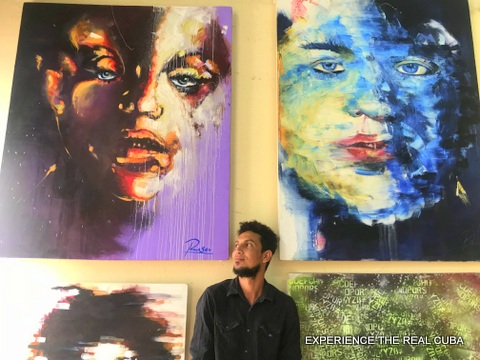
1. RAMSES MARRERO CONCEPCIÓN GALLERY
Ramses Marrero Concepción influenced by Impressionism is an Abstract Lyrical artist creating explosive pieces of art with the use of vivid colours. His artwork includes paintings of ocean landscapes, portraits and expressions. His recent project has been a bit controversial as he has traversed into new ground by highlighting the beauty of the female genitals in his work. His work has captured the interest of many on Instagram.
Yuniesky Fernández Frias’ passion for fishing is extremely evident in his artwork. His time on the open water is a time for reflection, to scrutinise on everyday ironies and transmit what he learns from the sea through his paintings. Yuniesky produces original and symbolic pieces of art, conveying messages from the times that we live in onto salvaged pieces of wood from old fishing boats. Yuniesky displays and works from his peaceful gallery which he opened around 2 years ago in Trinidad; he has been painting for around 16 years.
Gallery: Fernando Hernández Echerri 60, between Piro Guinart & Ciro Redondo, Trinidad, Cuba.
Gato Negro Open Studio is all about breaking barriers within the world of art and culture in Trinidad, Cuba. The studio which opened in May 2018 provides an incredible space for local talented artists to showcase their original artwork. It also aims to offer regular art experiences by holding musical concerts, interactive exhibitions, theatrical performances as well as creating a space which encourages cultural exchanges with local artists. The studio features the artwork of Miguel Angel Valdivia Ramos, Yasiel Elizagaray & Edras Francis.
Deep and intense compositions; Yasiel Elizagaray’s work has a way of reaching out and penetrating you, leaving you mesmerized and wanting to stare at it for hours. Yasiel himself questions his style, but it is an eclectic mix of styles. Depending on his state of mind, he throws in elements of his time in the theatre, of when he began painting landscapes, there are touches of Fauvism, some would say that his work is raw or grotesque however, the style he feels he relates to more when he is creating his work is Expressionism.
Gallery: Alameda 210, between Cristo & Amargura, Trinidad, Cuba.
Yudit Vidal Faife, one of Trinidad’s highly acclaimed artists, opened her gallery in Trinidad in 2010. Her motivation comes from dreams and stories that materialise all around her; from everyday life, personal life experiences, as well as personal anguishes. Trinidad is brimming with history and tradition, this reflects in Yudit’s artwork, which is strikingly linked to local legends, to the spirits and the ghosts, the slaves and the owners of the magnificent 18th century houses found all around Trinidad today, which she believes are kept alive and protected because of the spirituality locked up inside them.
Lázaro Niebla, a photographer and an artist, has a keen eye for detail, a talent for capturing heartfelt expressions of people on the street and recreating their portraits on beautiful pieces of antique recycled wood. He predominately captures images of older people, as their expressions are so full of life, and the detail of their expressions are captured beautifully on wood. Extraordinary and fabulous pieces of art.
Finca Tungasuk is an amazing project located 25 km from Havana on the road to Pinar del Rio, a slice of heaven, an inspiration to work alongside Annabelle and her beautiful organic farm in Cuba.
Annabelle arranged for her neighbour, Pedro, to pick me up, as well as Jeanne & Justin from Boston, 2 other volunteers, from our respective Casas in Havana at 7am.
As soon as we arrived, Annabelle welcomed us to her organic farm with some delicious home-made mango & guava yoghurt, made by a local farmer, grated coconut dessert and a cup of Cuban coffee. Before she set us to work in the farm, Annabelle told us all about her journey to Cuba and what led her to changing her life, buying a house in the countryside and starting an organic farm in Cuba.
Annabelle and her husband Alfredo moved to Cuba from Paris in 2013. Annabelle originally from Nicaragua was working as a chef in Paris when her and her Peruvian husband decided to open an organic farm in Cuba and work as a cooperative within the community. Cuba seemed like a natural choice to them as Alfredo’s parents had settled in Cuba in 1997 and it seemed like the perfect place to build their dream.
The initial year was tough, they had to clear the land free of the Cuban weed maribou to prepare the beginnings of their organic farming project. It took a lot of research and determination to learn about organic farming, however they have learnt from their experiences and have shared their knowledge with the local community in Caimitas, Artemisa.
Their hard work has paid off and now they are growing traditional Cuban fruit and vegetables; papaya, sugar cane, corn, mango. They are trying to revive fruits and vegetables indigenous to Cuba, which have been lost over time, as well as growing pak choi, lemon grass and other produce not commonly found and grown in Cuba.
As well as running the organic farm Annabelle and Alfredo now welcome volunteers to their farm looking to experience something different in Cuba. Our voluntary work at the organic farm in Cuba consisted of re-planting tomato, cauliflower and pack choi plants on a fresh plot of land where they will be nurtured without chemicals to grow into delicious organic vegetables. The experience left the 3 of us even more appreciative of the hard work farmers like Annabelle and her family endure when producing healthy, organic, fresh products for us to eat.
After our hard work, we enjoyed a scrumptious lunch with Annabelle’s family before Pedro took us back to Havana, totally grateful for meeting Annabelle and her family, for welcoming us into their world and for having the opportunity to take part in this wonderful Cuban experience.
Experience the Real Cuba offers cultural activities and programs in Cuba supporting local Cuban private businesses, as well as organising accommodation in Casa Particulares.
A Casa Particular in Cuba is like a B&B, guesthouse, or family homestay. WHAT FACILITIES DO CASAS IN CUBA OFFER?
Casas in Cuba vary,
sometimes rooms are within the Cuban family home and sometimes guest
accommodation in a Casa Particular is on a different floor with an independent
entrance. Most of the time bedrooms in a Casa Particular come with private en-suite
bathrooms. Rooms in a Casa Particular have air-conditioning or fans and the Casas
provide towels. Some Casas in Cuba are starting to offer additional facilities
for example, hairdryers, mini-bar, tv, safety boxes etc.
Whatever the conditions,
Cuban families are friendly, welcoming, and respect your privacy. Staying in a
Casa Particular is a great way to experience Cuba but just bear in mind that
Cuba has its shortages so water may be scarce, hot water may not be as hot as
you are used to or it may take time to heat up, towels may be smaller than you
are used to and things run slowly so the key to making the most of your
experience in Cuba is to be patient and take things in your stride.
WHY ARE CUBAN
CASAS CALLED HOSTALS?
You will find
that some Cuban Casas have named themselves Hostal XXX i.e. Hostal Misleydis & Gustavo. This is another term they use denoting that they have a guest
house, B&B, homestay or Casa Particular in Cuba. It is not necessarily a
backpacker or budget hostel.
ARE THERE ANY BACKPACKERS
OR HOSTELS IN CUBA?
I have stayed
in a couple of backpacker type accommodations in Havana, however, there are
very few backpacker or hostel type accommodations available in Cuba where
tourists on a budget visiting Cuba can share a room with other travelers or
backpackers i.e. a shared room for 6 people with bunk beds.
HOW DO I KNOW IF THE CUBAN CASA IS
LEGAL?
Cuban Casas who are legally allowed
to rent their homes to foreign visitors or travelers have a blue and white
sticker posted on their front door. Anyone that stays at a Cuban Casa must sign
the guestbook. Cuban Casa owners then have to report to immigration with your
passport details declaring who is staying with them in their Casa Particular.
HOW DO I BOOK A CASA IN CUBA?
Experience the Real Cuba works
with a network of Casas in Cuba. The Casa Particulares that we work with are
friends and contacts that we have made over the years and have been carefully
selected for their professionalism and excellent hospitality.
To book one of our many Casas in
Cuba and ensure you have an amazing stay in Cuba hit the following link:
Communicating with Casas in Cuba
can be difficult. Internet connection in Cuba is a challenge and it is not always
easy for Cubans to connect to the WIFI in Cuba every day.
At Experience the Real Cuba we communicate
with the Casas in Cuba on your behalf. We have Co-ordinators located in Cuba
who have an excellent relationship with the Casas in Cuba and we aim to get
back to Cuban Casa enquiries as fast as we can.
HOW DOES THE CUBA CASA BOOKING WEBSITE WORK?
At Experience the Real Cuba we
work in conjunction with the Casas in Cuba to offer the easiest Cuban Casa booking
system for both the Casa and the traveler visiting Cuba.
EXPERIENCE THE REAL CUBA – SUPPORTING CUBAN
BUSINESSES
Experience the Real Cuba offers Casas Particulares
in Cuba as well as cultural activities and programs in Cuba supporting local
Cuban private businesses.
Yes, you can buy a SIM card for your mobile phone when
you are on holiday in Cuba.
WHERE CAN I BUY A SIM CARD IN CUBA?
You can go to any ETECSA office in Cuba to buy a
Cuban SIM card.
I went to the ETECSA office located at the bottom
of the FOCSA building in Vedado on calle M in Havana. When I arrived at the
ETECSA office there were 2 queues. You need to know who is last in the queue so
ask for “el ultimo”, this is a general rule in Cuba. The gentleman asked me
what for “para que?” as each queue serves a different purpose so I said “para
sacar una linea” and he pointed me to the relevant queue. The line-up for the
queue was outside in the sun and a security guard inside the ETECSA office waved
us in one at a time when there was a sales person available to deal with our
enquiry.
I was lucky as I was in the queue for around 5-10
minutes, which is quick for Cuban standards, sometimes you can be in the queue at
ETECSA for a lot longer, especially when going to an ETECSA office in the provinces
around Cuba, so it is probably best to go to an ETECSA office in Havana.
In general, things in Cuba are not always available
when you want them. Sometimes you can be waiting in a queue for 1 hour only to
find out that there are no Cuban SIM cards available to buy when you get inside
the ETECSA office. One way to avoid this from happening is to speak the security
guard inside the ETECSA office and ask if there are any Cuban SIM cards for
sale before you join the queue.
DO I NEED IDENTIFICATION TO BUY A CUBAN SIM CARD?
When you go to buy a SIM Card in Cuba, you need to take
the following items with you:
Passport
Cuban Casa address (where you are staying)
a mobile phone / handset (the one you want to use when you are in Cuba)
money to pay for the SIM card (Cuban Converitible Pesos – CUC)
You should take the mobile phone with you because the
sales person wants to insert the chip into the mobile phone to check that is
functioning. I prefer taking an old mobile phone with me to Cuba so I can use
to communicate with friends and family in Cuba, i.e. to make local calls within
Cuba.
HOW DOES THE CUBAN SIM CARD WORK?
There is only one telecommunications company in
Cuba; ETECSA, there are no other service providers in Cuba offering mobile
phone contracts (November 2017).
You have 2 options, neither options include a mobile
phone or handset, so remember to bring a mobile phone with you to use in Cuba:
1. Permanent SIM Card
The permanent Cuban SIM card costs 40 CUC, it comes with 10 CUC credit. Before
I leave Cuba if I add credit to my phone the line will remain active for 11
months, so when I return to Cuba I can use the same SIM card and Cuban mobile phone
number. If I am away from Cuba for more than 11 months, I can charge the phone
online via various online service providers (I tend to use DING or Cuballama)
to keep the line activated.
2. Temporary SIM Card
The temporary Cuban SIM Card is 3 CUC per day. This is a good option for people who are on holiday in Cuba for a short time.
WHERE CAN I TOP UP MY CUBAN MOBILE PHONE CREDIT?
There are many private businesses acting as agents
for ETECSA in Cuba. They can be working from their Casa or have a small shop.
You will see small ETECSA signs posted on doors or windows, or you can ask your
Casa host in Cuba to let you know where your nearest agent is so you can add
credit to your Cuban SIM card.
SUPPORTING CUBAN BUSINESSES
Experience the Real Cuba offers cultural activities
and programs in Cuba supporting local Cuban private businesses, as well as
organising accommodation in Casa Particulares.